
There are NBA stories built around five-star recruiting rankings, blue-blood programs and national attention from the moment a player enters college.
Chaz Lanier's story is different.
His rise wasn't linear. It wasn't built on being an immediate college star. And it certainly wasn't the kind of path where NBA scouts had been circling his name for years.
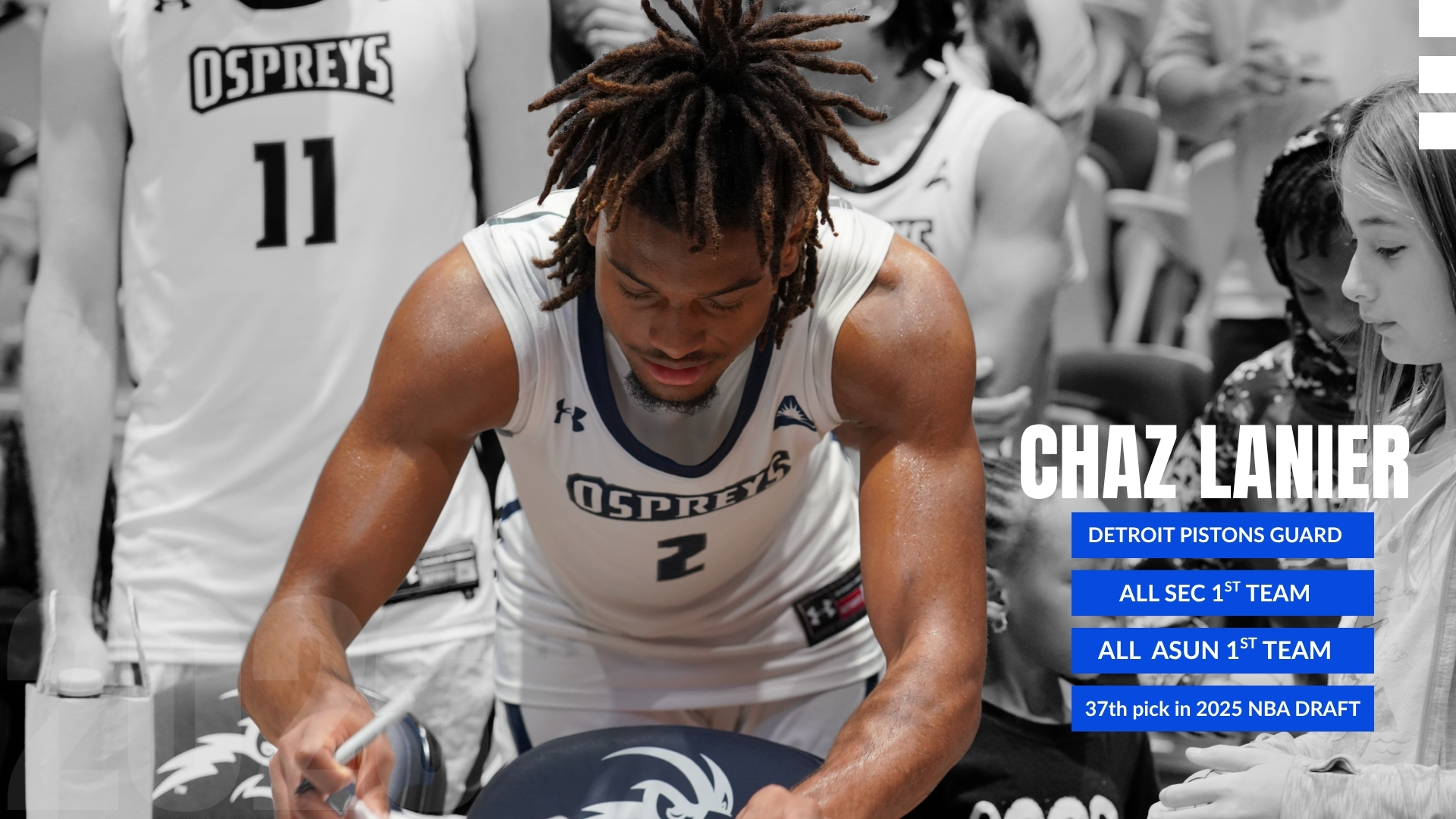
It was a gradual transformation that took him from North Florida to Tennessee, from a productive mid-major scorer to one of the nation's best shooting guards, and ultimately to the Detroit Pistons as the No. 37 pick in the 2025 NBA Draft.
Now, heading into his second NBA season, Lanier represents something increasingly valuable in basketball: proof that development can dramatically change the trajectory of a player.
The North Florida chapter
Lanier arrived at North Florida after playing high school basketball at The Ensworth School in Nashville.
His first season at North Florida, 2020-21, was essentially a redshirt year. The player who eventually became an NBA draft pick wasn't immediately visible. His emergence came gradually.
By his sophomore season, Lanier began making noise, including earning an ASUN Player of the Week honor.
But even then, he wasn't an overnight phenomenon.
The real breakthrough came later.
During his final season at North Florida, Lanier averaged 19.7 points, 4.8 rebounds and 1.8 assists, while shooting 44% from three-point range. He became a First Team All-ASUN selection and earned NABC First Team All-District honors.
That season fundamentally changed his trajectory.
Lanier wasn't simply scoring a lot. He was becoming an elite shooter.
At North Florida, he shot 51% from the field, 44% from three and 88% from the free-throw line during his final season, producing one of the most efficient offensive seasons of his career. In league play, he actually cleared the vaunted 50/40/90 thresholds.
He finished his North Florida career with a 40.7% three-point percentage and 86.4% free-throw shooting.
Suddenly, there was a much bigger question:
What could Lanier do against SEC competition?
Tennessee changed everything
Lanier transferred to Tennessee for the 2024-25 season.
That decision put him on a much larger stage, but it also meant something else: he now had to prove that what he had done at North Florida wasn't simply a product of playing at a lower level.
He answered that question emphatically.
In his lone season with the Volunteers, Lanier started all 38 games, averaging 18.0 points, 3.9 rebounds and 1.1 assists while shooting 43.1% from the field and 39.5% from three.
Then came the three-point barrage.
Lanier made 123 three-pointers, establishing a Tennessee single-season record. Those 123 threes were also sixth-most in a single season in SEC history.
He wasn't simply a good shooter anymore.
He was one of the most dangerous perimeter scorers in college basketball.
Lanier scored in double figures 36 times during his Tennessee season. He scored at least 20 points 15 times and reached 25 points six times.
Against Texas A&M on February 22, 2025, he erupted for 30 points while making 8-of-13 from three.
And the awards started piling up.
Lanier won the Jerry West Award, presented annually to the nation's top shooting guard. He was named SEC Newcomer of the Year, earned First Team All-SEC recognition and received All-American honors from multiple organizations.
The same player who had taken years to fully establish himself at North Florida had transformed into an elite SEC scorer in a single season.
The numbers tell the story
Across his five-year college career, Lanier played 142 games, scoring 1,613 points while shooting 40.2% from three-point range.
At Tennessee, his 684 points ranked among the best single-season scoring totals in program history. His 123 threes established a school record. He also finished his Tennessee career ranked highly in multiple categories, including career scoring average and three-point percentage.
And that's where his story becomes particularly interesting.
The NBA wasn't drafting the North Florida version of Chaz Lanier.
It was drafting the player he had become after years of development.
Detroit saw the shooter
On draft night, the Detroit Pistons selected Lanier No. 37 overall.
The selection made him the second Tennessee player ever selected by Detroit, joining Allan Houston, who was taken 11th overall in 1993.
Detroit wasn't simply betting on his college production.
The organization was betting on a skill that translates: elite shooting.
A player who can consistently space the floor, relocate, punish defensive mistakes and make shots from deep has obvious value in today's NBA.
And Lanier had already demonstrated that ability at multiple levels.
North Florida.
Then Tennessee.
Now Detroit.
The first NBA season
Lanier's rookie season was understandably a different challenge.
The jump from college basketball to the NBA is enormous, and his role with Detroit was limited. He appeared in 34 games, averaging 2.4 points, 0.7 rebounds and 0.5 assists in 7.7 minutes per game.
Those numbers don't tell the entire story.
Detroit had a successful season, and Lanier was part of a young roster developing together. The Pistons' own season notes highlighted that he was part of the team that finished with the best record in the Eastern Conference.
And then came the summer.
The second-year opportunity
If his rookie season was about adjusting to the NBA, his second summer offered something different:
production.
In the 2026 Las Vegas Summer League, Lanier showed exactly why Detroit invested in his shooting.
He scored 25 points against Cleveland, making 9-of-17 shots and 7-of-12 three-pointers. The following night against the Knicks, he scored 24 points while going 8-of-12 from three.
That doesn't guarantee an expanded NBA role, but it is an encouraging reminder of the skill that carried him from North Florida to Tennessee and ultimately into the NBA.
The bigger story
The most fascinating part of Chaz Lanier's journey isn't that he eventually became a second-round pick.
It's how much development happened between the beginning and the destination.
North Florida gave him the platform to become a legitimate college scorer.
Tennessee gave him the stage to prove he could do it against elite competition.
The Jerry West Award established him as one of the nation's premier shooting guards.
The SEC recognized him as its Newcomer of the Year.
The NBA came calling.
And Detroit turned that progression into an investment.
That's a remarkable amount of growth in a relatively short period.
The player who once had to wait his turn at North Florida eventually became a player setting Tennessee records.
The player who wasn't immediately viewed as a national star eventually became a Jerry West Award winner.
The player who spent four years building his game at a mid-major program eventually became the 37th player selected in the NBA Draft.
And now he enters Year 2 with another opportunity to prove that the story isn't finished.
Because if Lanier's career has taught us anything so far, it is this:
Don't confuse a late breakthrough with a late arrival.
Sometimes the player who takes longer to emerge is the player who has spent the most time building the foundation.
Chaz Lanier's foundation was built at North Florida.
His national breakthrough happened at Tennessee.
His NBA journey began in Detroit.
Now comes the next chapter.
And considering how far he has already traveled, the most intriguing question may not be how he got here.
It's how much further he can go.