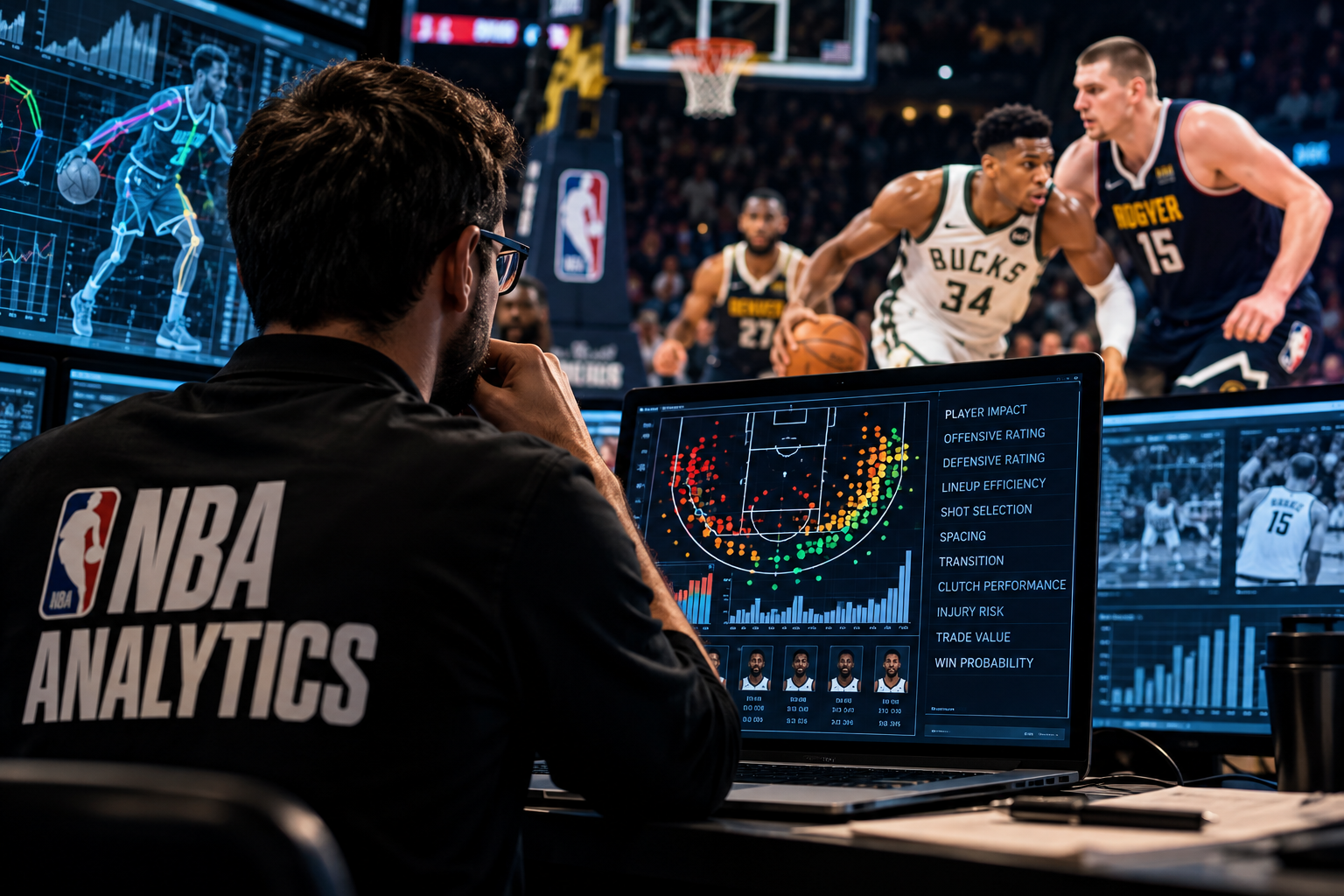
A groundbreaking study from the Massachusetts Institute of Technology suggests NBA teams may be overlooking one of their most valuable assets. Researchers found that investing in basketball analytics personnel can deliver performance improvements comparable to spending millions of dollars on player salaries.
For decades, NBA franchises have invested enormous amounts of money in acquiring superstar talent, building coaching staffs, and developing championship-caliber rosters. But research from the Massachusetts Institute of Technology (MIT) suggests one of the league's most valuable contributors may not wear a jersey or even sit on the bench.
The data analyst.
A study published in the Journal of Sports Economics in 2025 found that NBA teams employing more basketball analytics professionals consistently demonstrated stronger regular-season performance, even after researchers accounted for factors such as roster salaries, player injuries, coaching continuity, and team experience.
Perhaps the most surprising finding was the estimated financial value of those contributions. Researchers determined that adding approximately 0.8 of an analytics staff position was associated with one additional regular-season victory. Achieving a similar improvement through increased player salaries was estimated to require approximately $9.6 million.
The findings suggest that analytics departments could represent one of the most cost-effective competitive investments available to professional basketball organizations.
The $9 Million Question: Are NBA Analysts Undervalued?
NBA franchises routinely commit tens of millions of dollars to players expected to improve their championship chances. However, the MIT research raises an important question about how teams distribute their resources.
What if hiring an additional analytics professional could deliver a competitive improvement comparable to spending millions more on the roster?
Researchers Henry Wang, Arnab Sarker, and Anette Hosoi examined NBA performance across 12 seasons, analyzing how investment in basketball analytics influenced team success.
Their statistical models indicated that one additional analyst was associated with approximately 1.25 additional victories per season.
That might not sound significant in an 82-game NBA schedule, but a single victory can determine playoff positioning, home-court advantage, or whether a franchise reaches the postseason altogether.
The researchers also estimated that generating one additional victory through increased roster spending required approximately $9.3 million to $9.6 million, depending on the model and calculation.
The comparison does not mean analysts earn or directly generate $9 million in revenue. Instead, it highlights the potential competitive value of their contributions relative to traditional player spending.
For front offices looking to maximize their resources, the implications are significant.
NBA Analytics Departments Have Grown More Than 1,000 Percent
The NBA's relationship with analytics has changed dramatically over the past two decades.
In 2009, researchers identified just 10 basketball analytics professionals working across the entire league.
By 2023, that number had grown to 132.
Today, every NBA franchise employs at least one basketball analytics professional, with some organizations maintaining significantly larger departments.
This expansion reflects a fundamental transformation in how professional basketball teams operate.
Analytics personnel are increasingly involved in scouting, player development, contract evaluations, injury prevention, roster construction, and game strategy.
Their responsibilities extend far beyond traditional statistical analysis.
Modern analysts help organizations evaluate how individual players influence team performance, identify weaknesses in opposing defenses, and determine which combinations of athletes produce the most efficient results.
In many cases, their findings influence decisions involving millions of dollars.
How Analytics Have Changed the Way Basketball Is Played
One of the clearest examples of analytics influencing basketball is the NBA's three-point revolution.
Over the past decade, teams have increasingly prioritized three-point attempts, shots near the basket, and opportunities to reach the free-throw line.
The shift reflects an increased emphasis on scoring efficiency and expected points per possession.
While traditional basketball philosophies often emphasized midrange shooting and post play, modern offensive systems increasingly rely on spacing, ball movement, and mathematically favorable scoring opportunities.
Analytics have also changed how teams evaluate individual players.
A player averaging 12 points per game might provide greater overall value than someone averaging 20 if that player contributes more efficiently through defense, spacing, rebounding, and decision-making.
Advanced statistical models allow organizations to evaluate contributions that may not appear in conventional box scores.
These insights can influence everything from starting lineups to trade negotiations.
The Competitive Advantage of Finding Undervalued Talent
Perhaps the greatest value of basketball analytics lies in identifying talent that other organizations overlook.
NBA franchises spend millions on scouting departments and player personnel operations, but traditional evaluations remain influenced by subjective observations.
Analytics provide another layer of information.
A prospect who lacks impressive scoring averages may demonstrate exceptional defensive versatility, efficient shot selection, or an ability to elevate teammates.
Similarly, an established player whose traditional statistics appear impressive may be less effective when evaluated through lineup efficiency and overall team impact.
For franchises operating under salary-cap restrictions, identifying these differences can create a meaningful competitive advantage.
Rather than simply targeting the most recognizable names, organizations can identify players whose contributions exceed their market value.
The result is potentially more efficient roster construction and better long-term financial decisions.
Artificial Intelligence Could Take Basketball Analytics Even Further
As artificial intelligence becomes increasingly integrated into sports technology, basketball analytics is entering another phase of development.
Machine learning systems can process enormous quantities of statistical information, video footage, and player-tracking data.
These technologies can help identify patterns that would be difficult for human evaluators to recognize consistently.
AI-assisted basketball analysis has the potential to improve several areas of the game, including player evaluation, defensive scouting, injury-risk assessment, and performance development.
Video analysis is particularly important.
Instead of manually reviewing hours of footage, advanced systems can help identify specific possessions, player movements, defensive breakdowns, and tactical tendencies.
This allows coaching staffs and scouting departments to spend more time interpreting information and less time collecting it.
However, the growing availability of AI technology does not automatically eliminate the importance of human analysts.
The ability to interpret results, understand basketball context, and communicate findings to coaches and executives remains essential.
In fact, more sophisticated technology may increase the demand for professionals who understand both basketball and data science.
What This Means for High School and College Basketball
Although the MIT study focused on the NBA, its findings raise important questions about the future of basketball development and recruiting.
Professional organizations have historically enjoyed significant advantages in their ability to collect, analyze, and interpret player-performance data.
But improvements in video technology, artificial intelligence, and digital scouting tools are making advanced evaluation methods increasingly accessible.
High school programs, grassroots organizations, college coaches, and independent trainers now have opportunities to incorporate data-driven evaluation into their development systems.
For athletes, this could fundamentally change how exposure and recruiting work.
Traditional recruiting has often emphasized scoring averages, physical measurements, rankings, and highlight videos.
Those factors will remain important, but deeper performance analysis could provide a more complete understanding of an athlete's abilities.
Defensive positioning, shot efficiency, decision-making, off-ball movement, and performance against different levels of competition could become increasingly valuable evaluation metrics.
This shift could particularly benefit athletes who contribute significantly to winning but do not consistently produce eye-catching statistical performances.
It also reinforces the importance of maintaining accessible game footage and reliable performance records throughout an athlete's development.
As evaluation methods become more sophisticated, the ability to demonstrate performance through complete game film and supporting data could become increasingly important.
Can Analytics Replace Traditional Basketball Knowledge?
Despite the study's findings, analytics cannot replace every aspect of basketball evaluation.
Leadership, competitiveness, chemistry, confidence, and the ability to perform under pressure remain difficult to measure precisely.
Basketball is also influenced by unpredictable circumstances, including injuries, officiating decisions, player development, and changes in team dynamics.
Statistical models can identify patterns and estimate probabilities, but they cannot guarantee outcomes.
The MIT research also does not suggest that franchises can continue hiring analysts indefinitely and expect unlimited improvements.
The researchers acknowledged that analytics investments eventually produce diminishing returns.
The greatest advantage likely comes from finding the right balance between analytical resources, coaching expertise, and player talent.
Successful organizations must ultimately translate information into decisions that improve performance on the court.
The Future of Basketball May Be Decided Behind the Scenes
The MIT study highlights a broader transformation taking place throughout professional sports.
Organizations are increasingly competing not only through talent acquisition but also through their ability to collect information, evaluate performance, and make smarter decisions.
For NBA franchises, the implications extend beyond analytics staffing.
The research suggests that investing in infrastructure, technology, and specialized personnel can create measurable competitive advantages without requiring the same financial commitment as acquiring another highly paid player.
As artificial intelligence and advanced performance analysis continue to evolve, the importance of these investments could grow.
The next major competitive advantage in basketball may not come from a blockbuster trade or a record-breaking contract.
It may come from the people working behind computer screens, identifying opportunities that everyone else missed.
In a league where a single victory can separate contenders from pretenders, MIT's research suggests the smartest investment might not always be another player. It might be the person who knows how to get more out of the players already on the roster.