There are losses that come down to one play. Then there are losses where the final play becomes the headline because everything that happened before it created the conditions for that moment.
That is what happened Saturday night in Nashville.
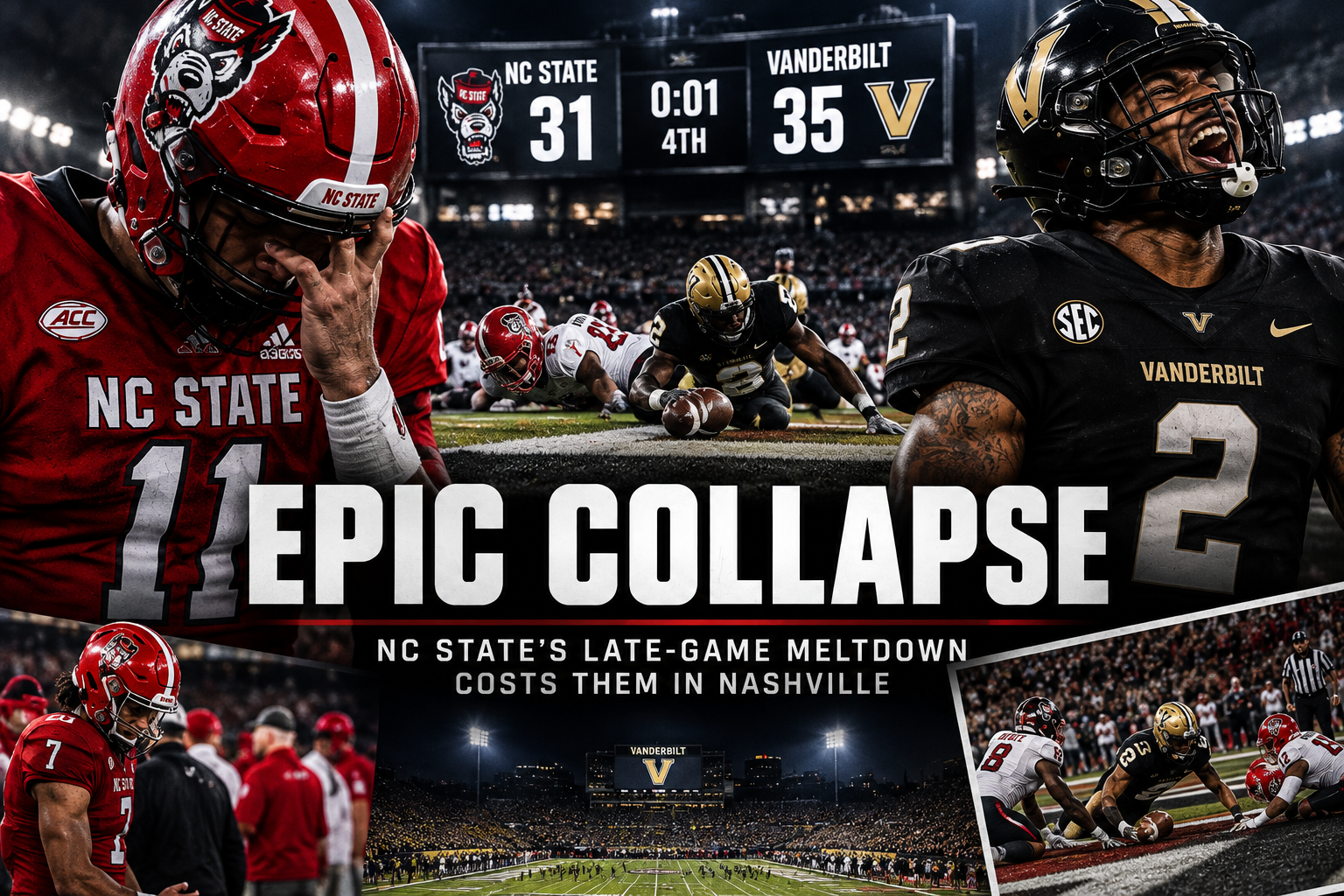
NC State led Vanderbilt 31-28 with just over a minute remaining, had the ball, and then somehow watched a game it had controlled for most of the afternoon turn into a 35-31 Vanderbilt victory on a fumble recovered in the end zone with one second remaining. The final sequence was extraordinary, but the Wolfpack had several opportunities before that final snap to make sure the game never reached that point.
The ending will understandably center on quarterback CJ Bailey's fumble, but putting the entire loss on that moment misses the larger story. NC State had a 17-0 lead, a 24-7 lead, a 31-28 lead in the final minute and, after an interception with 1:04 remaining, possession at its own 2-yard line.
That should have been enough.
It wasn't.
The First Missed Opportunity Came Earlier
The final disaster actually started before NC State ever took possession at its own goal line.
With approximately two minutes remaining, NC State had an opportunity to put the game away in Vanderbilt territory. Instead, the Wolfpack failed to convert on fourth down, giving Vanderbilt one more possession while trailing by only three points.
That decision became enormously important because Vanderbilt immediately had another chance to tie or win.
The Commodores took advantage, eventually scoring on a 43-yard touchdown pass from Jared Curtis to Junior Sherrill to cut NC State's advantage to 31-28.
Had NC State converted that fourth down, the entire final sequence could have looked dramatically different.
A conversion could have allowed the Wolfpack to drain additional clock, force Vanderbilt to spend its remaining timeouts and potentially extend the lead.
Instead, Vanderbilt stayed alive.
Then NC State Got What Should Have Been the Game-Sealing Turnover
And this is where the game becomes almost impossible to explain without looking at the entire sequence.
With 1:04 remaining, Vanderbilt quarterback Jared Curtis threw an interception that NC State's Brody Barnhardt picked off near the Wolfpack's own 2-yard line.
NC State had the lead.
Vanderbilt had no more offensive possession unless NC State gave it one.
The game was essentially in NC State's hands. The Guardian, citing ESPN's historical data, noted that teams had been 1,046-1 over the previous 20 seasons when leading and possessing the ball with 10 seconds remaining, with Michigan State's 2015 win over Michigan being the lone loss in that dataset.
And NC State still found a way to lose.
The Decision That Will Be Discussed All Week
NC State eventually faced fourth-and-3 from its own 5-yard line with six seconds remaining.
Instead of simply punting, the Wolfpack elected to run a play designed to bleed the remaining clock and ultimately take an intentional safety.
The logic was understandable: give Vanderbilt two points, make the score 31-30, and then use the free kick with essentially no time remaining.
But the execution introduced an unnecessary variable.
Bailey took the snap, retreated and attempted to burn the final seconds. Vanderbilt's Miles Capers got to him, knocked the ball loose, and Cayden Van Daniels recovered the fumble in the end zone.
Touchdown.
Game over.
Vanderbilt 35, NC State 31.
So How Could NC State Have Avoided It?
There wasn't just one alternative.
1. Convert the earlier fourth down
This was the first major opportunity.
NC State had the ball in Vanderbilt territory with roughly two minutes remaining and could have potentially ended the game by converting.
Instead, the turnover on downs gave Vanderbilt another opportunity to score.
This is important because the Wolfpack's final defensive interception came only after Vanderbilt had already been handed another possession.
2. Punt after the interception
Once Barnhardt intercepted Curtis at the 2-yard line, NC State could have taken the conservative route and punted.
That would have given Vanderbilt possession with virtually no time remaining and forced the Commodores to cover an enormous amount of field.
It wouldn't have been completely risk-free. Football rarely gives you a zero-risk option. But it would have removed the possibility of a defensive touchdown on a fumble in NC State's own end zone.
The AP specifically identified punting as one of the alternatives available to NC State.
3. Take the safety without trying to manufacture extra time
This is where the final decision becomes particularly interesting.
The plan was to take a safety.
The problem wasn't necessarily the concept of accepting two points. It was creating a live football play in which Bailey had to retreat, avoid pressure, protect the ball and somehow make the clock disappear.
As Doeren explained afterward, the intention was to roll out, burn time and then go down while protecting the football. Instead, Bailey was hit before he could safely execute the plan.
A quarterback simply going down in the end zone or running out of the back of it would have produced the intended safety without exposing the ball to a strip.
4. Get the ball out of the quarterback's hands
Another possibility was to remove the quarterback from the equation altogether.
A punt would have done that.
A deliberately executed play designed around safely getting rid of the ball would have changed the risk profile as well, although fourth-down execution and field position still matter.
The key issue was that the Wolfpack did not need a successful offensive play.
They needed the clock to expire without losing possession.
Those are very different objectives.
5. Protect the football above everything else
This may sound obvious, but it became the central failure of the final play.
NC State didn't need yards.
It didn't need a first down.
It didn't need to create offense.
It needed to avoid a turnover.
Doeren acknowledged that afterward, saying the plan was to burn as much time as possible and protect the football.
The moment Bailey was hit, the entire strategy collapsed.
And That Is Why the Loss Was Bigger Than One Fumble
NC State's offense was actually highly productive.
Bailey finished 25-of-37 for 275 yards and three touchdowns, while Keenan Jackson caught nine passes for 102 yards and three touchdowns. The Wolfpack totaled 446 yards, including 280 passing and 166 rushing.
They also forced three turnovers.
They led 17-0.
They led 24-7.
They led 31-21 in the fourth quarter.
And they had the ball with a three-point lead and barely a minute remaining after intercepting Vanderbilt's quarterback.
That is why the ending is so difficult to reduce to "Bailey fumbled."
The fumble was the final domino.
The earlier fourth-down failure, Vanderbilt's ability to stay within one score, the defensive breakdown that allowed the 43-yard touchdown, and the decision to use a risky clock-draining play from the 5-yard line all formed the sequence that made the final disaster possible.
Vanderbilt Deserves Credit, Too
There is another side to this.
Vanderbilt did not simply receive a gift and walk away.
The Commodores erased a 17-point deficit, survived multiple NC State scoring opportunities and continued fighting after falling behind 31-28.
Freshman quarterback Jared Curtis threw for 277 yards and three touchdowns, and Vanderbilt finished with 409 total yards. The Commodores also forced NC State into the final fourth-down situation that ultimately produced the game-winning fumble.
That matters.
NC State's mistakes created the opening, but Vanderbilt still had to take advantage of them.
And it did.
The Bottom Line
The most remarkable part of this game isn't simply that NC State fumbled with one second left.
It's that the Wolfpack had multiple opportunities to prevent the game from ever reaching that snap.
Convert the earlier fourth down.
Extend the lead.
Punt after the interception.
Take the safety without exposing the football.
Or simply execute the final play with absolute priority on ball security.
Any one of those decisions could have changed the final sequence.
Instead, NC State went from having the game essentially secured to watching Vanderbilt celebrate a touchdown in the end zone.
31-28 with the ball and 1:04 left became 35-31 Vanderbilt with one second left.
That's not just a bad ending.
That's a game that slipped away one decision at a time.