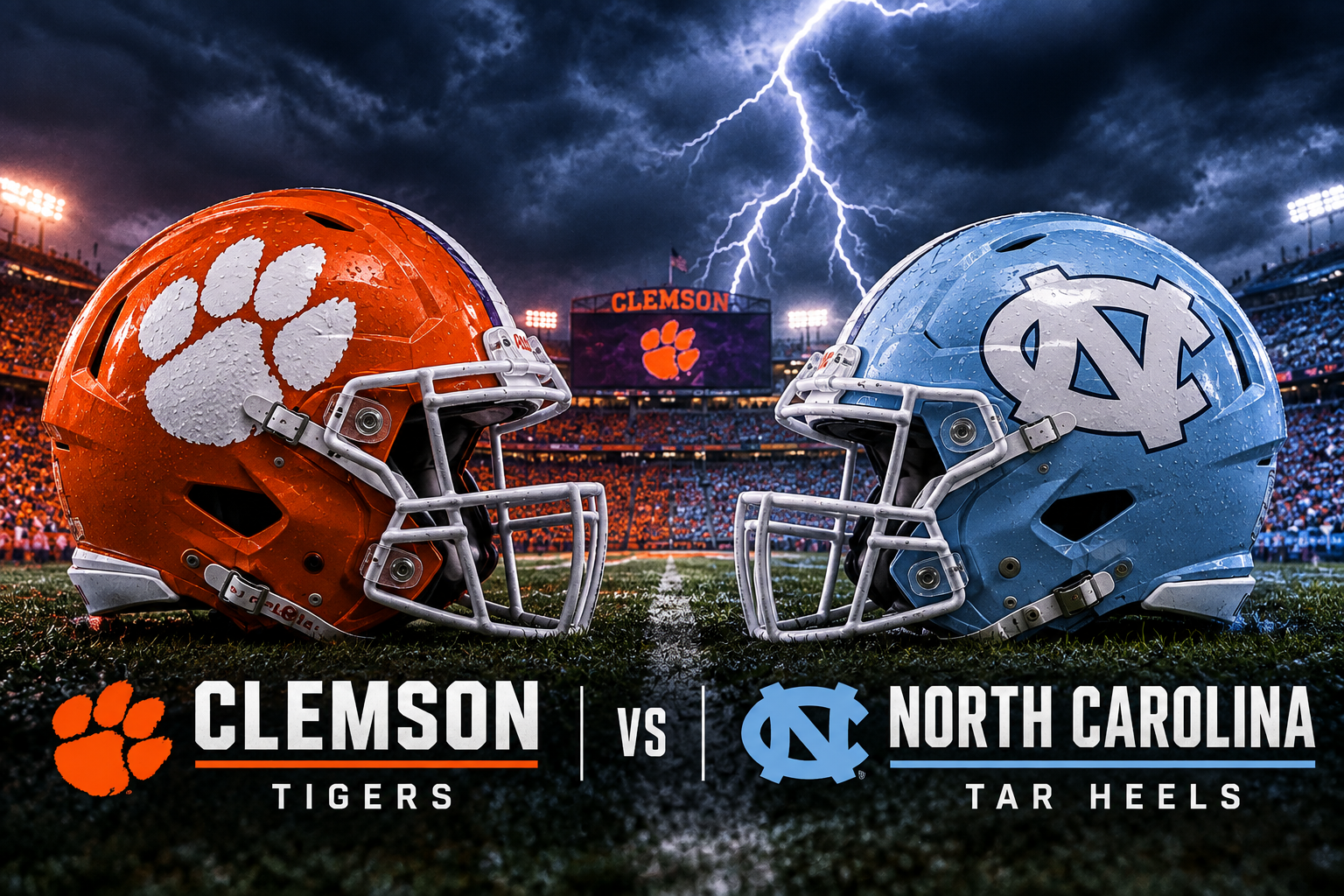
Clemson 28, North Carolina 20.
The final score makes this look like a Clemson comeback that happened in the final eight minutes. The reality was more complicated. North Carolina controlled the opening half, but Clemson had already begun changing the game well before the lightning delay interrupted the fourth quarter.
UNC opened the ACC matchup with a 17-3 lead, scoring touchdowns on its first possession and a 75-yard drive in the first quarter. Benjamin Hall caught a 15-yard touchdown from Billy Edwards Jr., and Aeron Burrell added a 33-yard field goal in the second quarter.
Then Clemson started chipping away.
The Tigers closed the first half with an 18-play, 88-yard drive that ended with a field goal, cutting the deficit to 17-6. That possession mattered because Clemson wasn't simply waiting for something to happen. It was sustaining drives and forcing North Carolina's defense to stay on the field.
The third quarter made the momentum shift even clearer.
Clemson intercepted Edwards at the UNC 2-yard line, and although the Tar Heels immediately forced another field goal, the Tigers continued getting points. Later in the quarter, freshman quarterback Tait Reynolds connected with Christian Bentancur on a 27-yard touchdown, completing a 92-yard drive. Clemson was suddenly within 17-15.
That is important context before discussing the weather.
The Lightning Delay Didn't Create Clemson's Momentum
With 8:11 remaining, North Carolina was driving inside Clemson territory when lightning stopped play.
The delay lasted 2 hours and 28 minutes, a Clemson Memorial Stadium record. When the game stopped, UNC was leading 17-15 and had the ball at the Clemson 7-yard line, facing second-and-goal.
This is where the game becomes fascinating.
The delay unquestionably came at an enormous moment for North Carolina. The Tar Heels had a chance to turn a five-point lead into a much larger advantage.
But saying the delay caused Clemson's comeback doesn't tell the whole story.
Clemson had already cut a 14-point deficit to two points.
The Tigers had scored 9 points in the third quarter, had created turnovers and had put together a 92-yard touchdown drive. The momentum was already moving.
The weather interruption simply stopped both teams at a critical moment.
When they returned, UNC couldn't finish the drive.
Two runs by Demon June gained three yards, and Burrell converted a 22-yard field goal, putting North Carolina ahead 20-15 with 6:34 remaining.
Three points kept Clemson within one possession.
And Clemson immediately attacked.
Gideon Davidson Changed the Game
Clemson needed only four plays and 68 yards.
Gideon Davidson broke through for a 45-yard run, putting Clemson inside the UNC 10. Two plays later, the sophomore running back scored on an eight-yard touchdown run.
Clemson led 21-20.
Davidson finished with 105 rushing yards on 16 carries, while Clemson finished with 401 total yards, including 186 rushing yards. Reynolds completed 20 of 29 passes for 215 yards and a touchdown in his first career start.
That's why the fourth quarter can't simply be reduced to the weather delay.
Clemson's offense had already found another gear.
Then Came the Fourth-and-Short Decision
This is where the discussion around North Carolina's play-calling becomes legitimate.
After Clemson took its first lead, UNC had another opportunity to respond. Instead, the Tar Heels failed to convert on fourth down, turning the ball over to Clemson.
The Tigers immediately turned that possession into another touchdown.
Tyler Brown broke a 34-yard touchdown run, pushing Clemson's lead to 28-20 with one minute remaining.
The fourth-down decision will naturally receive attention because of the situation: North Carolina needed to sustain the drive, and the failed conversion gave Clemson another possession while the Tigers had completely seized control.
But there is a bigger point here.
North Carolina had multiple chances to stop the comeback.
The Tar Heels had a 17-3 lead.
They still led 17-15 entering the fourth quarter.
They had the ball at the Clemson 7-yard line when the lightning delay began.
They came back from the delay still leading 20-15.
And after Clemson went ahead 21-20, UNC still had another possession.
Clemson simply kept winning the next important moment.
The 25-3 Run Tells the Story
The most revealing statistic might be the simplest one.
After North Carolina went ahead 17-3, Clemson outscored UNC 25-3 over the remainder of the game. The Tigers scored 22 second-half points while North Carolina managed only three.
That's not a weather-delay statistic.
That's a football statistic.
The lightning delay became one of the defining images of the afternoon because of its timing, but Clemson's comeback was already developing before the skies opened.
The Tigers had established the run. Davidson eventually surpassed 100 yards. Reynolds settled into his first start. Clemson's defense created turnovers and repeatedly kept UNC from turning opportunities into touchdowns.
And when the game reached its decisive stretch, Clemson made the explosive plays.
A 45-yard run.
An eight-yard touchdown.
A fourth-down stop.
A 34-yard touchdown.
An interception to finish it.
That's how a 17-3 North Carolina lead became a 28-20 Clemson victory.
UNC's Missed Opportunities Will Be the Bigger Conversation
For North Carolina, the frustrating part isn't simply that the lightning delay interrupted its rhythm.
It's that the Tar Heels still had opportunities after the interruption.
They could have scored seven instead of three from the Clemson 7.
They could have answered after Clemson took the 21-20 lead.
They could have converted the critical fourth down and kept possession.
Instead, Clemson took advantage of each opening.
So the better way to describe this game isn't "the rain delay cost North Carolina."
The more accurate story is that Clemson had already begun taking control before the delay, the delay arrived at the worst possible moment for UNC, and North Carolina failed to regain control once play resumed.
That's what makes this Clemson vs. North Carolina game worth remembering.
It wasn't one play.
It wasn't just the weather.
It was a game that changed gradually, then suddenly.