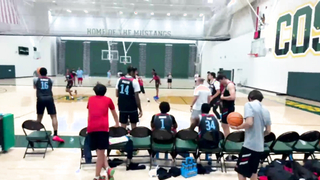
Loyola Marymount University's new-look basketball team showed flashes of its potential against California, controlling much of the contest before falling by a single point in a preseason scrimmage. Despite the loss, the Lions demonstrated why their Power Four additions could make them a dangerous team in the West Coast Conference.
For Loyola Marymount, the biggest takeaway from its preseason matchup against Cal wasn't necessarily the final score. It was the opportunity to evaluate how a revamped roster featuring transfers Jasai Miles from Indiana and Mazi Mosley from LSU could compete against Power Four opposition.
LMU led for much of the game before Cal rallied to secure a one-point victory.
The Lions showed encouraging signs, particularly on the defensive end and on the glass, but their offensive execution revealed areas that will need improvement before conference play begins.
The biggest concern? Ball movement.
Too Many Forced Shots, Not Enough Offensive Movement
One of the most noticeable issues with LMU's offense was the tendency for the ball to stick in the hands of the first offensive player initiating a possession.
Rather than consistently moving the defense through passing, penetration, and kick-outs, the Lions occasionally settled into possessions featuring forced shots.
That approach can make an offense predictable, particularly against disciplined defensive teams.
LMU has the personnel to create advantages off the dribble, but those advantages become more dangerous when the ball moves quickly after the initial penetration.
Driving into the paint, forcing defensive rotations, and kicking the ball out to open shooters should create more efficient scoring opportunities.
The Lions don't necessarily need more isolation basketball. They need better offensive connectivity.
And with their collection of talented transfers, that improvement could significantly raise their ceiling.
Jasai Miles Makes His Presence Felt Defensively and on the Glass
Indiana transfer Jasai Miles provided one of the more encouraging individual performances for LMU.
Miles' defensive activity and rebounding stood out throughout the contest, giving the Lions a physical presence capable of impacting possessions without needing to dominate the basketball offensively.
His ability to pursue rebounds from the guard position could become one of LMU's biggest advantages in WCC competition.
Miles has the potential to establish himself among the conference's best rebounding guards if he continues demonstrating that level of effort and positioning.
Equally important is his defensive versatility.
For a team hoping to compete against the WCC's strongest programs, having a guard who can defend, rebound, and contribute in multiple areas is extremely valuable.
Miles demonstrated those qualities against Cal.
However, his most important offensive opportunity may have come on the game's final possession.
The Final Possession Told the Story
With LMU trailing by one point in the closing moments, the Lions had an opportunity to steal the victory.
Miles was left wide open in the corner.
But the basketball never found him.
It was a possession that summarized one of LMU's biggest offensive concerns throughout the scrimmage.
Against quality opponents, recognizing and delivering the ball to open shooters is essential.
The final possession illustrated why improved court awareness, spacing, and ball movement must become priorities.
LMU had an opportunity to generate a quality look, but the offense failed to capitalize on the defensive opening.
These are the types of details that often determine close games.
For a team with postseason ambitions, correcting those mistakes early could make a significant difference.
Mazi Mosley Adds Another Dimension to LMU's Backcourt
LSU transfer Mazi Mosley is another important piece of LMU's revamped roster.
The 6-foot-5 sophomore brings Power Four experience and additional size to the Lions' perimeter rotation.
Mosley's offensive development and ability to operate within LMU's system will be important as the season progresses.
With Miles and Mosley joining the program, LMU has upgraded its perimeter personnel and added players accustomed to competing against high-level opposition.
The challenge now is turning that individual talent into a cohesive offensive unit.
LMU needs its guards to recognize when to attack, when to move the ball, and when to create opportunities for teammates.
The Lions have enough talent to generate quality shots. Their success will depend on consistently finding them.
What Does This Mean for LMU's WCC Championship Aspirations?
Despite the one-point loss, there are reasons for optimism.
LMU competed with an ACC opponent and, based on the flow of the scrimmage, demonstrated an ability to control stretches of the game.
The defensive effort and rebounding from Miles were particularly encouraging.
But competing with a Power Four opponent in October is different from consistently winning conference games.
If LMU hopes to challenge the WCC's top programs, offensive execution must improve.
The Lions need more purposeful ball movement, better penetration-and-kick opportunities, and stronger late-game decision-making.
Those improvements are achievable, particularly for a team still developing chemistry with several new contributors.
A Promising Start, but Work Remains
Ultimately, LMU's preseason loss to Cal should be viewed as a useful early evaluation rather than a major setback.
The Lions showed they can compete against quality opposition.
Miles demonstrated the defensive toughness and rebounding ability that could make him one of the WCC's most impactful guards.
Mosley's arrival provides additional offensive potential.
And the roster has enough talent to make LMU an intriguing team entering the 2026–27 season.
The biggest question is whether the Lions can develop the offensive chemistry necessary to maximize those pieces.
LMU has the personnel to make noise in the WCC. Now it needs to make the ball move as effectively as its players can.