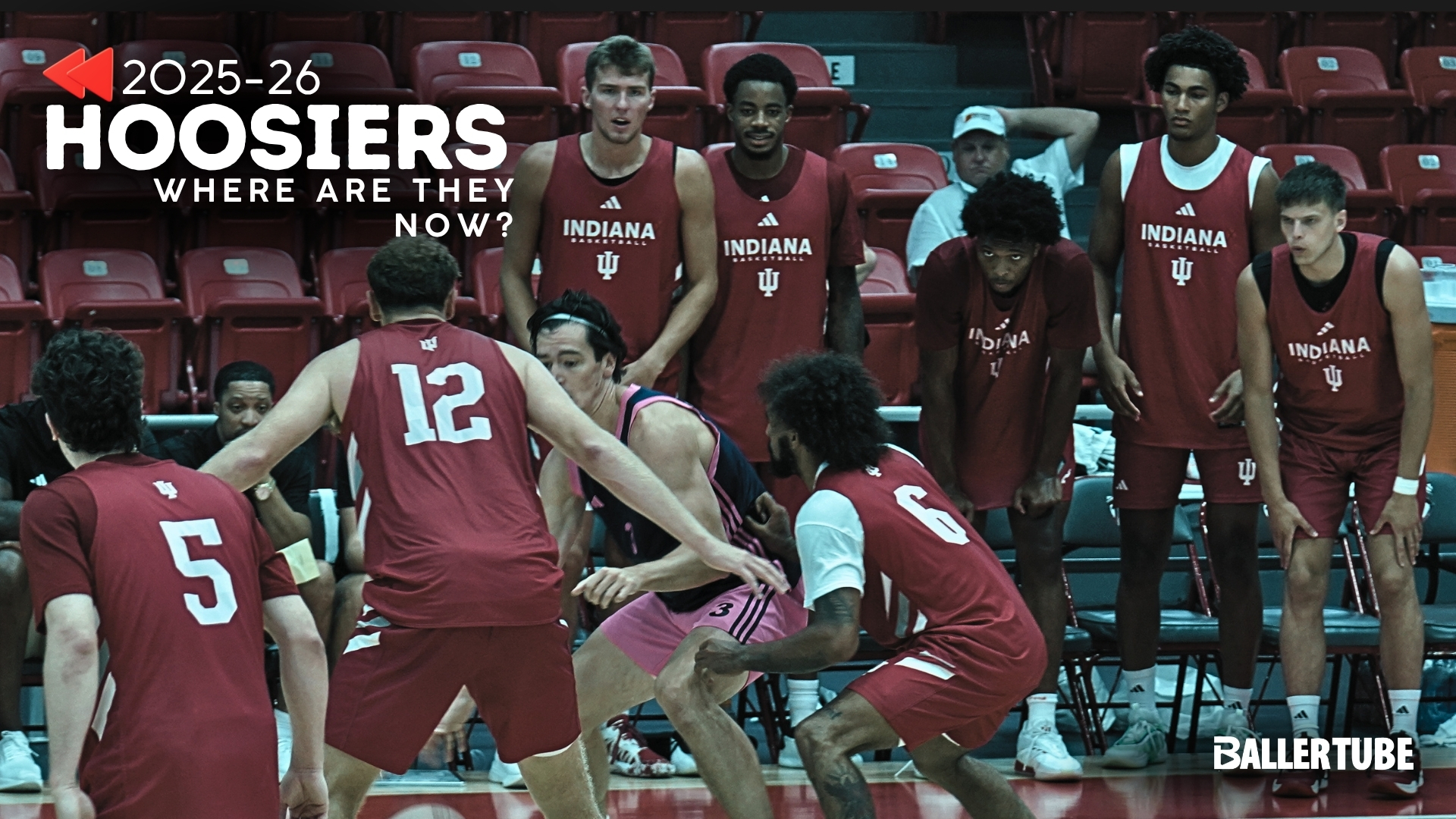

One Year Later, Where Are They Now? The Darian DeVries Roster at Indiana Has Almost Completely Disappeared
When Darian DeVries arrived at Indiana in March 2025, he inherited one of the strangest roster situations imaginable for a program of Indiana's stature.
It was essentially a zero-man roster.
Every scholarship player from Mike Woodson's final team who had remaining eligibility entered the transfer portal. Indiana's seven March portal departures included Gabe Cupps, Malik Reneau, Mackenzie Mgbako, Jakai Newton, Myles Rice, Kanaan Carlyle and Bryson Tucker. That left DeVries without a single confirmed returning scholarship player.
So DeVries did what the modern college game allows coaches to do.
He built an entirely new team.
And he did it fast.
Indiana ultimately brought in 10 transfers, retained four-star Indiana native Trent Sisley from its high school recruiting class, and entered the 2025-26 season with a roster that was almost entirely new.
The experiment produced an 18-14 record, a 9-11 Big Ten mark and no NCAA Tournament appearance.
But here's where the story gets interesting.
One year later, almost that entire team is gone too.
Not just the players who exhausted eligibility.
The players who still had eligibility left are gone as well.
That raises a much bigger question about the DeVries rebuild:
Was Year 1 simply a bridge to the roster he actually wanted?
Because if that's the case, Indiana's 2025-26 team wasn't really the foundation.
It was a one-year placeholder.
The First DeVries Roster Was Built Under Extreme Circumstances
It is important to understand what DeVries walked into.
This wasn't a situation where a new coach inherited eight or nine scholarship players and needed to add three or four pieces.
He had essentially nothing to work with.
DeVries was hired March 18, 2025, after one season at West Virginia and five successful seasons at Drake.
By the time the dust settled, Indiana had to build its roster almost completely through the transfer portal.
The result was a fascinating collection of players:
- Tucker DeVries
- Lamar Wilkerson
- Tayton Conerway
- Conor Enright
- Reed Bailey
- Sam Alexis
- Jasai Miles
- Jason Drake
- Nick Dorn
- Josh Harris
- Aleksa Ristic
- Andrej Acimovic
- Trent Sisley
The roster had players from Drake, West Virginia, Sam Houston State, Troy, DePaul, Davidson, Florida, North Florida, Drexel, Elon and international basketball.
It was a roster assembled in weeks.
And DeVries got it to 18 wins.
But the problem was that the roster never really became his program in the traditional sense.
There wasn't much continuity to begin with.
And now we know there would be even less going forward.
So Where Are They Now?
Let's go player by player.
Tucker DeVries → Boston Celtics
The most obvious connection to DeVries was his son, Tucker.
Tucker followed his father from West Virginia to Indiana and became one of the team's most important players.
He started all 32 games, averaged:
13.7 PPG
5.3 RPG
3.3 APG
1.1 SPG
He was also Indiana's leading rebounder.
Tucker went undrafted in the 2026 NBA Draft but quickly landed an opportunity with the Boston Celtics, signing an Exhibit 10 contract.
He also played in the Las Vegas Summer League, showing that his basketball career is continuing at the professional level.
Status: Boston Celtics / professional basketball
Lamar Wilkerson → Oklahoma City Thunder
Wilkerson might have been the biggest pure scorer on the roster.
The former Sam Houston State star exploded for Indiana, averaging:
20.9 PPG
3.5 RPG
2.4 APG
1.0 SPG
He knocked down 104 threes, becoming only the second Hoosier ever to make 100 in a season.
He also scored 44 points against Penn State, an Indiana single-game record, and hit 10 threes in that game.
Like Tucker, Wilkerson went undrafted.
And like Tucker, he immediately received an NBA opportunity.
Wilkerson signed an Exhibit 10 contract with the Oklahoma City Thunder.
Status: Oklahoma City Thunder / professional basketball
So two of DeVries' most important players from Year 1 are now trying to make NBA rosters.
Reed Bailey → St. John's
Bailey was one of the more experienced players on the roster, coming to Indiana after a highly productive career at Davidson.
At Indiana he averaged:
8.3 PPG
3.4 RPG
while shooting 57 percent from the field.
He is now at St. John's, where Rick Pitino added him as a graduate transfer.
That's an interesting destination because Bailey isn't simply going down a level. He's joining a program with legitimate national championship aspirations.
Status: St. John's
Nick Dorn → Miami
Dorn may be one of the more intriguing departures because he actually had eligibility remaining.
He wasn't pushed out by graduation.
He chose to leave.
Dorn started 12 games for Indiana and averaged:
8.1 PPG
2.3 RPG
38.0% from three
He became an important perimeter shooter late in the season and finished with 60 made threes.
Now he's back in Florida with Miami, where Jai Lucas added him as a senior guard.
Status: Miami
And this is exactly where the story gets more interesting.
Indiana didn't simply lose players because they were finished.
It lost players who could have returned.
Josh Harris → Florida Atlantic
Harris might be one of the most interesting cases.
Before Indiana, he had already demonstrated that he could produce at the Division I level.
At North Florida as a freshman, he averaged:
13.4 PPG
7.1 RPG
and earned All-ASUN Freshman Team honors.
His Indiana season wasn't nearly as productive.
He entered the portal after one year.
Now he's at Florida Atlantic, where he joins former Indiana teammate Kanaan Carlyle.
FAU clearly sees more in Harris than Indiana's rotation showed.
Status: Florida Atlantic
Jasai Miles → Loyola Marymount
Miles spent one season at Indiana after transferring from North Florida.
He played 26 games but averaged just:
1.6 PPG
1.9 RPG
He entered the portal after the season.
He's now headed to Loyola Marymount.
Status: Loyola Marymount
Jason Drake → Temple
Drake is a particularly unusual case because he never really got the chance to show what he could do at Indiana.
He transferred from Drexel after averaging:
11.1 PPG
3.0 RPG
3.1 APG
in 33 starts.
But a lower-body injury suffered during the summer kept him out for the entire 2025-26 season.
He entered the portal after the season and is now headed to Temple.
Status: Temple
Aleksa Ristic → Belmont
Ristic was a young Serbian guard who barely played at Indiana.
He appeared in 12 games and averaged 0.5 points.
Now he's at Belmont, where the program views him as a significantly more interesting developmental piece.
Ristic brings legitimate international experience, including Serbian national-team experience and participation on Serbia's 2023 FIBA U18 European championship team.
Status: Belmont
Andrej Acimovic → Missouri State
Acimovic never played a game for Indiana.
He redshirted the entire 2025-26 season.
The 6-foot-10 Bosnian center is now at Missouri State, where Cuonzo Martin added him for 2026-27.
Missouri State specifically cited his size, skill, passing ability and shooting potential.
Status: Missouri State
Sam Alexis: The One That Isn't So Simple
Alexis was originally considered gone.
He was one of Indiana's top seven scorers and was initially out of eligibility.
Then the courts changed the situation.
A Tennessee court injunction temporarily granted him a fifth season, and Alexis announced that he would return to Indiana.
Then the Tennessee Court of Appeals stayed that injunction.
So as of September 6, 2026, Alexis is currently ineligible to play, although the legal situation remains unresolved.
That matters enormously.
Because Alexis averaged:
8.8 PPG
4.8 RPG
1.2 APG
while shooting nearly 69 percent from the field.
If he eventually becomes eligible, he could give DeVries a veteran frontcourt piece.
If not, he's another major piece from Year 1 that isn't available.
And Then There's Trent Sisley
This might be the most important name in the entire story.
Because Sisley is essentially the only player from the 2025-26 team who was originally expected to provide continuity.
He averaged:
4.2 PPG
2.8 RPG
as a freshman.
At one point, he was literally the only confirmed returning player for 2026-27.
That's remarkable.
A coach takes over a blue-blood program.
Builds a roster from scratch.
Wins 18 games.
And one year later, almost the entire roster is gone.
The Numbers Tell the Story
Indiana's 2025-26 team finished 18-14 and 9-11 in the Big Ten, finishing 10th in the conference and missing the NCAA Tournament for the third consecutive season.
But the more revealing number is this:
Six of Indiana's top seven scorers from 2025-26 were originally expected to be gone because of eligibility.
Tucker DeVries
Lamar Wilkerson
Tayton Conerway
Conor Enright
Reed Bailey
Sam Alexis
And the seventh, Nick Dorn, transferred.
So the team that took the floor in 2025-26 was never really going to be the team entering Year 2.
That is a massive reset.
DeVries Is Now Building the Team He Actually Wants
This is the part that makes Year 2 so important.
DeVries doesn't have to recruit against the clock anymore.
He doesn't have to assemble an entire Big Ten roster in six weeks.
He has now had a full season inside the league.
He knows what the Big Ten requires.
And his second roster reflects that lesson.
Indiana went much bigger in the portal.
The 2026-27 class includes:
Markus Burton from Notre Dame
Aiden Sherrell from Alabama
Samet Yigitoglu from SMU
Jaeden Mustaf from Georgia Tech
Bryce Lindsay from Villanova
Darren Harris from Duke
Justin Monden from Maryland Eastern Shore
Plus the incoming high school class.
This isn't the same type of roster DeVries built in 2025.
And that's probably intentional.
Indiana itself acknowledged the lesson.
The school described the 2025-26 roster as lacking Big Ten size, strength and perimeter quickness, something DeVries and his staff specifically addressed in the 2026 offseason.
This Is Where We Have to Give DeVries Some Credit
It would be easy to look at the turnover and say:
"He couldn't keep anybody."
That's not entirely fair.
He didn't inherit a roster.
He inherited a vacancy.
He needed bodies immediately.
And he managed to put together a competitive Big Ten team quickly enough to win 18 games and beat teams such as Purdue, UCLA and Wisconsin.
The problem is that Indiana wasn't hired to simply be competitive.
It's Indiana.
And the 2025-26 season ended with another NCAA Tournament miss.
The next question wasn't:
Can DeVries build a roster?
We already know he can.
The question became:
Can he build a roster that stays together long enough to become a team?
The Transfer Portal Creates a Strange Paradox
This is the bigger college basketball story.
The portal makes it possible for a coach to rebuild faster than ever.
But it also makes it possible for a coach to rebuild every year.
And those are two very different things.
DeVries has now experienced both extremes.
At Indiana, he went from:
No returning roster → 10 transfers → 18-14 → almost complete roster turnover → another major transfer class.
That is essentially two rebuilds in two years.
At some point, the program has to stop rebuilding and start retaining.
That's where Indiana's second season becomes much more revealing than its first.
The Real Question Isn't "Where Did They Go?"
It's:
Why didn't they stay?
That's the question Indiana fans should ultimately be asking.
Because some of these departures make perfect sense.
Tucker DeVries and Lamar Wilkerson are pursuing professional basketball.
Reed Bailey used his remaining eligibility to move on to St. John's.
But then there are the players who still had eligibility and simply moved on after one season in Bloomington.
Nick Dorn left for Miami.
Josh Harris left for Florida Atlantic.
Jason Drake left after missing the 2025-26 season with injury.
Jasai Miles left after playing 26 games as a reserve.
Aleksa Ristic left for Belmont.
Andrej Acimovic, who redshirted and never played a game for Indiana, also entered the portal.
Those aren't necessarily failures individually.
But collectively, they tell you something.The Bottom Line
One year ago, Darian DeVries was handed an Indiana basketball program with essentially no returning scholarship roster.
He built one.
One year later, that roster has almost completely disappeared.
Tucker DeVries is trying to make the Celtics.
Lamar Wilkerson is trying to make the Thunder.
Reed Bailey is at St. John's.
Nick Dorn is at Miami.
Josh Harris is at FAU.
Jasai Miles is at Loyola Marymount.
Jason Drake is at Temple.
Aleksa Ristic is at Belmont.
Andrej Acimovic is at Missouri State.
Tayton Conerway and Conor Enright exhausted their eligibility Sam Alexis' situation is tied up in the courts.
And Trent Sisley is the lone true piece of continuity from that first DeVries roster.
That's an extraordinary amount of turnover in 12 months.
But maybe that's exactly what DeVries wanted.
Because Year 1 was about survival.
Year 2 is about proving the rebuild was real.
And if this new Indiana roster doesn't work?
Then the conversation changes.
Because at that point, DeVries won't be trying to explain away an inherited roster.
He'll be trying to explain his roster.
And that is a very different evaluation.